

Posted By admin
 May 20, 2025
 10:05:17am
 When it comes to real estate, documents are everywhere-from lease agreements and NOCs to inspection reports, client IDs, and purchase contracts. On average, real estate professionals spend about 50% of their time just preparing documents. Without a reliable solution, 25% of these documents are likely to get lost. Managing all this across departments, projects, and stakeholders is no small task.
In 2024, the U.S. real estate industry was valued at $236.4 billion. In a market this huge, how you manage your documents can make a big difference. That’s where a real estate document management system comes in. It helps property managers serve tenants and owners better, stay compliant, and quickly find any document-contracts, leases, or receipts-anytime, anywhere, with just a click.
Let’s explore how a real estate document management system can transform the way property managers securely handle the mountain of paperwork in both residential and commercial real estate.
Some real estate companies still rely on manual processes, email threads, shared drives, or paper records. While this might work for smaller teams, it quickly becomes challenging for companies managing hundreds or thousands of units. It works… until it really doesn’t.
Let’s say, a leasing officer at a major developer is tasked with renewing a tenant’s expired contract across three inboxes and a USB from 2019. She finds it-five days too late. The result? An upset tenant, delayed renewal, and a not-so-happy line manager.

A Real Estate Document Management System is a specialized software that helps property developers, leasing teams, and facility managers store, manage, retrieve, and track documents related to customers, properties, and transactions-all from one centralized platform.
Think of it as the management team of your real estate business-keeping every agreement, ID proof, approval, and financial document not just stored but accessible, actionable, and secure.
Less paper shuffling, more deal closing.
When evaluating a Real Estate Document Management System, ask:
If you’re in any of the following roles, this is for you:
Discover how Property-xRM helps real estate teams centralize, organize and manage documents across properties, customers, leases and transactions.
Explore Property-xRM Document Management →
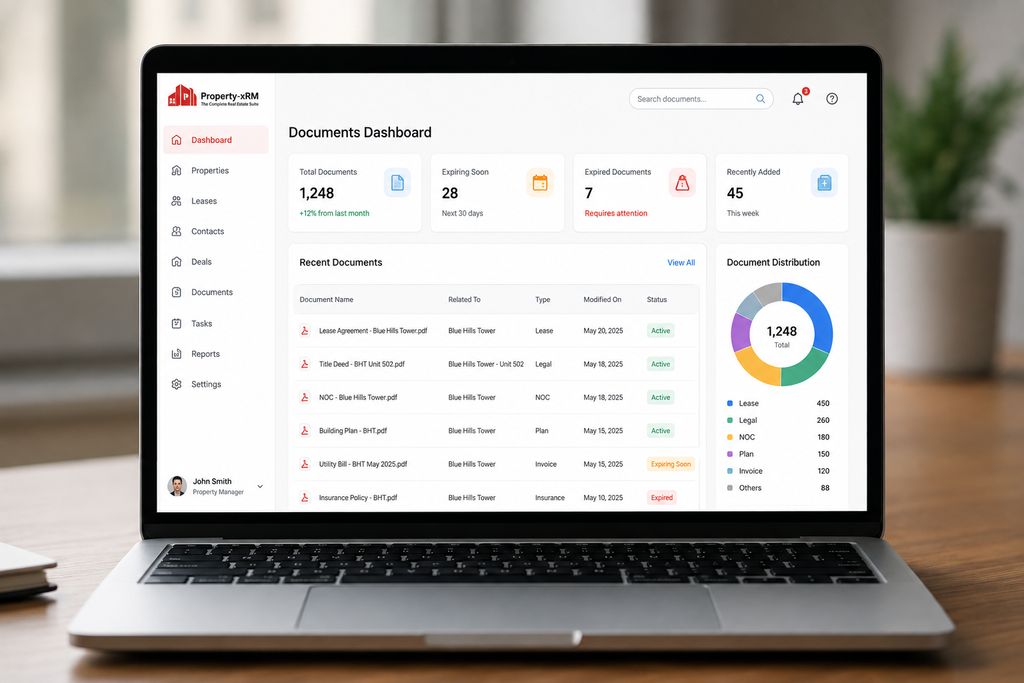
Say goodbye to scattered folders and endless email threads. With a centralized document repository, your sales, leasing, and legal teams can access documents from any project, anytime-from lease agreements and title deeds to NOCs and inspection reports-with just a few clicks in a single platform.
Imagine this: John is drafting a lease for a new tenant. At the same time, the legal team needs the title deed, and the sales team wants to check last year’s payment plan. Instead of chasing each other, they simply log into the real estate document management system, pull up the project, and access the files they need-instantly, from anywhere. No delays and no miscommunication, just seamless collaboration.
Staying on top of document expiry dates is critical. Whether it’s tenancy contracts, property management agreements, leasing licenses, or government approvals, missing a renewal can lead to legal trouble, fines, or even lost revenue.
A Real Estate Document Management System takes the stress out of this by automatically tracking expiry dates and sending timely alerts-well before deadlines approach.
Let’s say you’re managing multiple residential and commercial towers. Without a system, you have to track the expiries manually. But with a document management system in place, your dashboard shows upcoming expiries.
Like, “5 contracts in Tower A and 3 contracts in Tower C are expiring in the next 30 days.”
You get enough time to talk to tenants, update terms, or prep units for re-listing. This helps you retain tenants and avoid vacancies.
Every deal comes with its own set of documentation, especially when working with individual buyers, corporate tenants, or international investors. A document management system lets you create custom checklists for each type of client or transaction. Think items like passports, visas, trade licenses, and more.
Having a checklist means nothing gets missed, and the process stays fast, organized, and compliant.
Real estate operations involve multiple departments-leasing agents, finance, legal, and senior management-all needing access to the same documents at different stages of a deal. A document management system allows everyone to collaborate in real time, even if they’re working from different locations.
Team members can add notes, give feedback, or approve documents without sending files back and forth or waiting for someone to be in the office. You could even integrate tools like SharePoint to create a common platform where everyone-from site offices to HQ-stays in sync.
Imagine a leasing agent finalizing a lease for a retail space and uploading the agreement into the system. The finance team reviews and adds a note on payment terms. The legal team checks compliance and flags a clause for revision. Meanwhile, the leasing manager approves the deal directly from an email notification-all within a few hours.
This kind of real-time collaboration speeds up the lease process and keeps everyone aligned-no delays, no miscommunication.
In real estate, your documents often include sensitive information-tenant IDs, payment details, legal agreements, and more. A document management system with role-based access controls ensures that only authorized team members can view or edit specific documents. This keeps your data secure and aligns with internal compliance policies.
Let’s say your leasing team needs access to signed lease agreements but not to the tenant’s payment history. Meanwhile, the finance team needs to view invoices and receipts, but shouldn’t access the tenant’s ID or passport copy. With role-based access, you can set permissions so each team only sees what’s relevant to them.
This helps protect confidential data, reduces the risk of errors, and ensures compliance with privacy policies and audit requirements.
Real estate deals often get delayed because of paperwork-especially when tenants, buyers, or signatories are in different locations. With e-signature tools like DocuSign, you can send lease agreements, sale contracts, or NDAs digitally and get them signed remotely in minutes.
Once signed, the document is automatically saved under the respective client or property record-no need to print, scan, or courier anything.
A Real Estate Document Management System isn’t just about staying organized-it’s about building a more responsive, compliant, and scalable operation. Whether it’s digitizing client onboarding, managing expiring contracts, or enabling seamless collaboration, the right system transforms how you work.
That’s where Property-xRM comes in. As an operational real estate CRM powered by Microsoft Dynamics 365, Property-xRM allows you to generate and manage documents -such as SPAs, Reservation Agreements, Invoices, and Receipts-enforce template standards, and securely store them-all within the CRM itself for quick and easy access.
Need renewal alerts or compliance notifications? Those can be triggered automatically from within the system too.
With built-in integrations to SharePoint, Outlook, and Teams, Property-xRM becomes more than just a document hub-it’s a centralized digital workspace for your sales, leasing, and operations teams.
If you’re looking to take control of document management and improve overall efficiency, Property-xRM is a solution worth exploring.
As real estate portfolios grow, storing documents in separate folders for every project, building and tenant can make information increasingly difficult to manage.
A centralized real estate document management system can connect documents with the relevant project, property, unit, customer, lease or transaction while making information easier to retrieve across the portfolio.
Property-xRM helps real estate organizations manage documents in the context of their operational records rather than relying only on disconnected folder structures.
When documents are stored separately for every building or project, finding all relevant leases, contracts or customer records across the portfolio can become difficult.
A structured system can help teams search and retrieve documents based on the associated property, customer, unit, lease or transaction instead of manually navigating through multiple folders.
This is particularly important for developers and property companies managing large portfolios across multiple projects or regions.
Many teams manually upload a document, classify it, extract information from it and then enter the same details into spreadsheets, trackers or other systems.
Connecting document management with operational records can reduce this duplication by keeping documents and their related business information together.
Property-xRM helps connect documents with real estate CRM and operational processes, reducing the need to manage the same information across disconnected systems.
Real estate organizations often handle passports, identification documents, financial records, contracts and other sensitive information.
A secure document management process should control who can access specific information and ensure employees only see documents relevant to their responsibilities.
Role-based access helps leasing, finance, sales and legal teams work with the information they need while reducing unnecessary exposure to sensitive documents.
Different teams often require access to different documents. Leasing teams may need contracts, finance may need invoices and receipts, while legal teams require access to transaction documentation.
Role-based access allows organizations to define permissions based on responsibilities rather than giving every employee access to every document.
Property-xRM can support controlled access within a connected real estate operational environment.
As real estate portfolios grow, documents can quickly become difficult to manage when teams rely on deeply nested folders for every project, building, unit, tenant and transaction.
A better approach is to connect documents with the relevant property, customer, unit, lease or transaction so teams can find information based on the business context rather than remembering where a file was stored.
For large real estate portfolios, this makes it easier to retrieve documents across projects and departments while reducing the complexity of managing multiple disconnected folder structures.
Real estate teams often spend time downloading attachments from emails, renaming files, moving documents into folders and chasing missing paperwork.
Document automation and connected workflows can reduce these repetitive activities by standardizing how documents are generated, stored and associated with relevant business records.
Property-xRM supports document generation and management within real estate operational processes, helping teams reduce dependency on disconnected manual filing.
When contracts and other records are stored in personal inboxes, desktops or employee-managed folders, they can become difficult for the organization to locate after someone leaves.
A centralized document management approach keeps important records connected to the relevant property, customer or transaction rather than depending on an individual employee’s storage.
This helps maintain continuity across sales, leasing, finance and operations.
Yes. SharePoint can provide strong document storage, collaboration and document management capabilities. However, real estate organizations may also need documents to be connected directly with properties, units, customers, opportunities, leases and operational workflows.
Property-xRM can work alongside SharePoint while adding real estate-specific CRM and operational context around the documents.
Yes. Document automation can generate standardized documents using information already stored in the operational system.
For example, customer, property, unit and transaction information can be used to generate reservation agreements, SPAs, invoices and receipts.
Property-xRM supports document generation and template standardization, helping teams reduce manual preparation and maintain consistency.
Real estate transactions often require multiple documents from customers, tenants, buyers and internal teams. Missing documents can delay sales, leasing, onboarding and compliance processes.
Document checklists and structured workflows can help teams identify what has been received and what is still outstanding.
Property-xRM can support document-related processes within the wider customer and transaction workflow.
When documents are spread across emails, personal drives and multiple shared folders, preparing for an audit can require significant manual effort.
Centralizing documents and connecting them to the relevant customer, property, lease or transaction makes information easier to locate when required.
For enterprise real estate organizations, controlled access and structured document processes can also support stronger governance and compliance practices.